
Santa Clarita Vinyl Fence: Project example: a tan woodgrain vinyl privacy fence racked down a Val Verde hillside, 160 feet with a short step at the corner — what it looks like and what it costs
Santa Clarita Vinyl Fence takes a typical hillside project for a rural home in Val Verde: 160 linear feet of 6-foot tan woodgrain vinyl privacy fence along the rear and uphill side of a lot that slopes toward the road, built mostly as racked panels that follow the grade and stepped only at one steep corner, in a textured tan finish picked to sit quietly against the hills.
Project Examples & Typical Prices
Worked example. The pictures are AI concept illustrations, not photographs; no installation was performed or arranged through this site; prices are typical Santa Clarita Valley market ranges, not quotes.
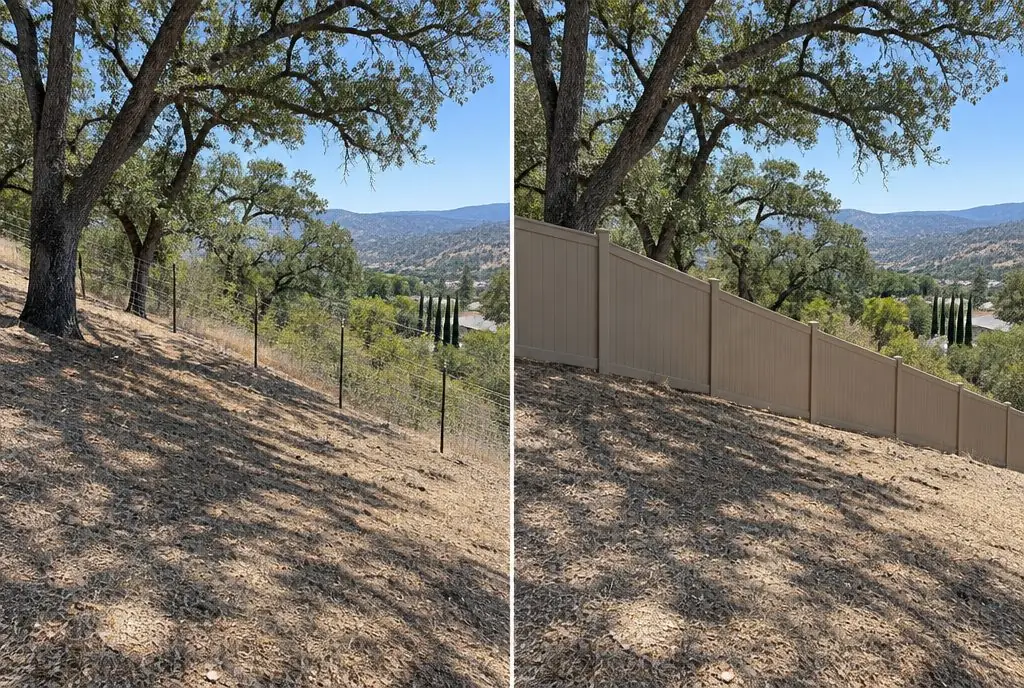 Illustration
Starting pointFinished layout (concept)
Illustration
Starting pointFinished layout (concept)
The scenario
The lot is one of the rural parcels in Val Verde, on the slopes between Castaic and the Santa Clara River, where houses sit on cut pads with yards that fall or rise toward unpaved easements and oak trees. This yard rises about six feet over the 100-foot rear run and then drops sharply at the uphill corner where a drainage cut passes, before continuing 60 feet along the side. A wire field fence on T-posts marks the line now and gives no privacy from the easement road behind. The soil is a rocky loam with roots from the oaks near the corner.
The brief is a 6-foot privacy fence in a tan woodgrain finish rather than white — a wood look without the painting and termite problems of real wood on a sunny slope — along the rear and the uphill side, 160 feet in all. Because the rear grade is gentle and steady, the panels are built racked, with the rails following the slope and the pickets staying plumb, which gives a continuous top line. At the steep corner, where racking would exceed what the panel allows, two bays are stepped instead. No gate is needed; the yard is reached from the driveway side.
The lot in short:
- Rear run: about 100 feet, rising roughly six feet steadily
- Side run: about 60 feet beyond a steep corner at a drainage cut
- Soil: rocky loam, with oak roots near the corner
- Existing fence: wire field fence on T-posts
- Finish: tan woodgrain vinyl instead of white
What the job involves
- The installer walks the line, confirms it against the easement boundary, marks the oak root zones to avoid near the corner, and arranges utility marking even though the lot has only a water line and a septic field on the far side.
- The grade along the rear run is shot with a laser level and the rise per 8-foot bay is calculated; where it falls within the rackable range of the privacy panel, the bays are planned as racked, and the two steep bays at the corner are planned as steps.
- Post centers are marked at 8-foot spacing from the house corner, with the corner post set where the grade change is sharpest so the stepped bays start and end on firm ground away from the drainage cut.
- Holes are augered 10 inches wide and about 30 inches deep, with the corner post going deeper; roots at the oak end are cut cleanly by hand rather than torn by the auger, and the rocky loam is broken with a bar.
- The tan woodgrain posts are set in concrete and plumbed to a string that follows the slope on the racked run and steps at the corner; after the cure, rails with aluminum inserts are angled into the routed posts, the pickets are slid in plumb, and the top rail is seated.
- Caps in matching tan go on, the stepped bays at the corner get a kick board to close the triangular gaps, the spoil is spread on the uphill side, and the fence line is cleared of wire and T-post stubs.
Hardware and materials
- 5-by-5 inch tan woodgrain vinyl posts routed for a rackable 6-foot privacy panel, with a deeper-set corner post
- Rackable privacy panels in the same tan woodgrain: aluminum-insert bottom rails, tongue-and-groove pickets and top rails sized for angled routing
- Two standard stepped bays for the steep corner with a matching tan kick board
- Laser level, long string line, auger with a 10-inch bit, digging bar, hand saw for roots, concrete and gravel
- Tan post caps and vinyl-safe adhesive
- Wire cutters and a T-post puller for the old field fence
What it typically costs in the Santa Clarita Valley
| 6 ft solid privacy, 160 linear feet installed ($38–$58 per foot) | $6,080–$9,280 |
| Sloped or stepped grade (+$4–$9 per foot) | +$640–$1,440 |
| Tan, gray or woodgrain vinyl instead of white | +$300–$900 |
| Typical total | $7,020–$11,620 (market range, not a quote) |
These are typical local ranges, not a quote or an offer; an installer prices the actual job after seeing the wall.
Add-ons often paired with this job
- Single walk gate (4 ft) — +$350–$650. A 4-foot gate onto the easement road is sometimes added for hauling brush; on a colored fence it is ordered in the same tan woodgrain.
- Decorative post caps (per run) — +$60–$180. Decorative caps in a matching tan are available for most woodgrain lines and are a small upgrade on a long run.
- HOA submittal package — +$100–$250. Val Verde lots are rarely in an association, but where a fence stands near a public easement a permit question can come up; the package is a separate item.
Why it is done this way
Racking is chosen for the rear run because the slope is gentle and continuous, and a racked privacy fence follows the ground with an unbroken top line, which looks right against open hills. Rackable panels are routed at an angle in the post and use pickets that can shift a little in the rail, so they cost more than a standard panel; the two stepped bays at the corner are where racking would run out of range, and stepping there is cheaper and stronger than forcing the angle.
The tan woodgrain finish is the other choice that defines this project. A colored, textured vinyl is a material surcharge over white, but on a sunny south-facing slope a wood fence would need staining every few years and white vinyl would glare, so a tan finish that hides dust and matches the hills is worth the difference. Roots at the oak end are hand-cut because tearing them with an auger stresses the tree, and the drainage cut is kept clear so the fence never dams a winter flow.
Where racking ends and stepping begins on this line:
- Racked: the gentle, steady rear run, within the panel's racking limit
- Stepped: the two steep bays at the corner, where racking would bind the pickets
- Transition: the corner post, set where the grade change is sharpest
What would change the price
- The rear grade is steeper than the panel's racking limit — more bays switch to stepped, which adds posts and the kick boards for the gaps.
- A boulder or a heavy root ball sits at a post location — relocating the post or hand-digging adds labor at that point.
- The old field fence has to be removed and its T-posts hauled — a per-foot removal line when it is part of the job.
- The brief calls for an 8-foot fence on the easement side for privacy from the road — a taller fence usually needs a permit and heavier posts, which changes the whole base rate on that run.
- The tan woodgrain profile is a special order with longer lead time — the schedule changes, and a different color line may carry a different surcharge.
Where this leads
- Service page: Vinyl Privacy Fence Installation — 6 ft solid tongue-and-groove panels on 5x5 posts in concrete, built for SCV wind. The most-requested fence in the valley.
- Local page: Vinyl fence installation in Val Verde
- All services and typical prices: vinyl fence installation in Santa Clarita
- More worked examples: Project Examples & Typical Prices
Check availability and the price range for this setup
Bookings aren't open yet — describe the fence line and you get a Santa Clarita price range right here. Per-foot ranges are typical Santa Clarita Valley installed prices for white vinyl, materials and labor. This is a market estimate, not a quote; footage is measured on site and the installer prices the actual job. City permit fees and HOA fees, where they apply, are not included.