
Santa Clarita Vinyl Fence: Project example: 140 feet of 6-foot privacy fence stepped down a sloped Canyon Country backyard — what it looks like and what it costs
Santa Clarita Vinyl Fence walks through a typical hillside project for a Canyon Country tract home: 140 linear feet of 6-foot white vinyl privacy fence along two sides of a backyard that drops about four feet from the patio to the rear corner, built in stepped panels so each section stays plumb and level, with a single walk gate where the side yard meets the driveway.
Project Examples & Typical Prices
Worked example. The pictures are AI concept illustrations, not photographs; no installation was performed or arranged through this site; prices are typical Santa Clarita Valley market ranges, not quotes.
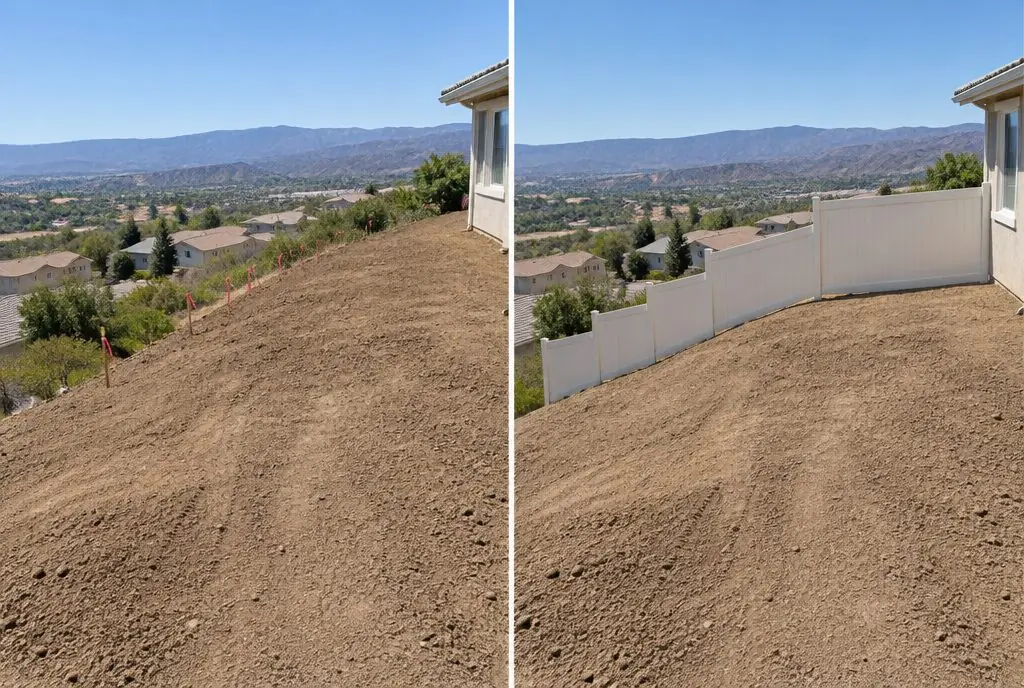 Illustration
Starting pointFinished layout (concept)
Illustration
Starting pointFinished layout (concept)
The scenario
The setting is one of the hillside tract homes along the canyons east of Sierra Highway, where the pad is flat near the house and then falls away toward the rear property line. The yard is a trapezoid: about 60 feet along the back and 80 feet down one side, with the grade dropping roughly four feet over that side run. The old chain-link fence from the original build is sagging and offers no privacy from the lot below. Survey pins are visible at both rear corners, and the side yard narrows to a strip beside the driveway where a gate belongs.
The brief is the usual one for this kind of lot: a solid 6-foot white vinyl privacy fence along the rear and the sloped side, a single 4-foot walk gate at the driveway end, and a top line that looks orderly from the patio rather than a sawtooth of random steps. Because the slope is steady but not steep, the fence is built in stepped sections: each 8-foot panel stays perfectly level, and the posts take up the grade change in equal drops. The soil is decomposed granite over clay, common in Canyon Country, which digs easily near the surface and gets hard a foot down.
The starting conditions at a glance:
- Run: about 140 linear feet on two sides, rear and sloped side
- Grade: roughly four feet of fall over the side run, steady rather than broken
- Soil: decomposed granite near the surface, hard clay about a foot down
- Existing fence: sagging chain-link from the original build
- Openings: one 4-foot walk gate where the side yard meets the driveway
What the job involves
- The installer walks the line with the survey pins and a string, confirms where the fence sits relative to the property line, and calls for underground utility marking before any hole is dug; the irrigation lateral along the side yard is flagged by hand with a probe.
- A transit or laser level is set up on the patio and the total fall along the side run is measured, then divided across the panels so every step is the same height; a drop of a few inches per panel reads as a clean staircase instead of a random zigzag.
- Post locations are marked at 8-foot centers with the walk gate opening laid out first, so the gate posts land where the side yard is widest; the corner post and the two gate posts are flagged for deeper, wider holes.
- Holes are augered 10 inches wide to about 30 inches deep for line posts and 36 inches for the gate and corner posts; where the auger hits hard clay, a digging bar breaks it up and the hole bottom gets a few inches of gravel for drainage.
- Each 5-by-5 post is set in concrete, plumbed in both directions against the string line, and held with temporary braces; the posts along the slope are set so the top of each one sits exactly one step lower than the one before it.
- Once the concrete cures, bottom rails with aluminum inserts are dropped into the routed post holes, tongue-and-groove pickets are slid in, the top rail is seated and locked, and the gate is hung on its reinforced post with self-closing hinges and a gravity latch.
- Post caps are glued on, the stepped bottom gaps are closed with a kick board or left as a uniform shadow line, and the yard is raked and cleaned of concrete spoil and vinyl shavings.
Hardware and materials
- 5-by-5 inch white vinyl posts, routed for a 6-foot privacy panel; 2-by-7 inch bottom rails with aluminum stiffener inserts and 2-by-3.5 inch top rails
- Tongue-and-groove privacy pickets, 8-foot panels, sized for the stepped layout
- Gate posts with internal aluminum or steel reinforcement, a 4-foot welded-frame vinyl walk gate, self-closing hinges and a gravity latch
- Fast-setting concrete, about two bags per line post and three per gate or corner post, plus a few inches of gravel per hole
- Gas-powered auger with a 10-inch bit, digging bar, transit or laser level, string line, post levels and temporary braces
- External post caps, vinyl-safe adhesive, and a kick board strip for the taller bottom gaps on the slope
What it typically costs in the Santa Clarita Valley
| 6 ft solid privacy, 140 linear feet installed ($38–$58 per foot) | $5,320–$8,120 |
| Sloped or stepped grade (+$4–$9 per foot) | +$560–$1,260 |
| Single walk gate (4 ft) | +$350–$650 |
| Typical total | $6,230–$10,030 (market range, not a quote) |
These are typical local ranges, not a quote or an offer; an installer prices the actual job after seeing the wall.
Add-ons often paired with this job
- Decorative post caps (per run) — +$60–$180. Decorative pyramid or solar caps replace the flat caps on a stepped run, and they read especially well along a descending top line.
- Tan, gray or woodgrain vinyl instead of white — +$300–$900. A tan or gray fence hides dust better than white on a hillside lot that faces the afternoon wind, at a surcharge on the material.
- HOA submittal package — +$100–$250. Where the community has design rules for fence height on a slope, a submittal package with the stepped elevation drawing is a separate line.
Why it is done this way
Stepping rather than racking is the right answer on this yard because the grade is even and the brief calls for a solid privacy panel. Tongue-and-groove pickets cannot tilt inside their rails the way a picket or ranch-rail fence can, so a privacy fence either steps in level sections or is built with custom-cut panels at a cost that rarely makes sense. Equal steps planned from a level survey are what make the finished line look designed rather than improvised.
The deeper holes at the corner and gate posts matter more on a slope than on a flat lot. A corner post takes rail load from two directions, and a gate post carries a swinging weight all day, so both are set in more concrete than a line post. The aluminum insert in every bottom rail keeps an 8-foot privacy panel from sagging in the summer heat, and it stiffens the fence against the Santa Ana gusts that funnel through these canyons every fall.
The alternatives that were weighed and set aside:
- Racking the privacy panels would need special rackable panels at a higher material cost for a grade that steps cleanly anyway.
- Regrading the side yard flat would mean a retaining wall, which is a separate structure with its own engineering and permit questions.
- Uneven steps that follow every bump are faster to lay out but read as improvised from the patio.
What would change the price
- The grade turns out steeper than it looks — more than a foot of drop per panel calls for shorter 6-foot panels or taller posts, which raises the per-foot slope rate and adds posts.
- The old chain-link fence has to come out — removal and haul-away of the posts and their concrete footings is a separate per-foot line.
- Caliche or a buried concrete footing at a post location — hand-breaking or relocating the hole adds labor at that post.
- A second walk gate at the rear corner for access to the lot below — each additional gate is priced as its own option.
- The community design committee requires a specific profile or color — a submittal package and a colored vinyl order change both the timeline and the material line.
Where this leads
- Service page: Vinyl Fence on a Slope (Stepped & Racked) — Stepped privacy panels or racked rail fences for hillside side yards and pad edges, with the bottom gap handled.
- Local page: Vinyl fence installation in Canyon Country
- All services and typical prices: vinyl fence installation in Santa Clarita
- More worked examples: Project Examples & Typical Prices
Check availability and the price range for this setup
Bookings aren't open yet — describe the fence line and you get a Santa Clarita price range right here. Per-foot ranges are typical Santa Clarita Valley installed prices for white vinyl, materials and labor. This is a market estimate, not a quote; footage is measured on site and the installer prices the actual job. City permit fees and HOA fees, where they apply, are not included.