
Santa Clarita Vinyl Fence: Vinyl Ranch Rail Fence Installation in Santa Clarita
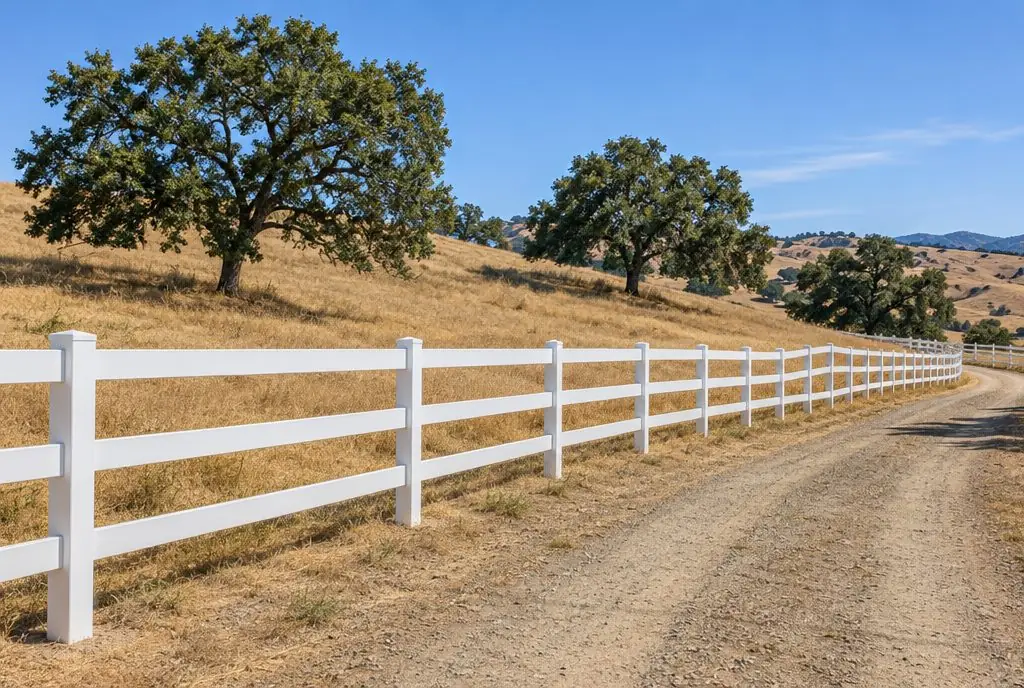
Santa Clarita Vinyl Fence covers vinyl ranch rail fence installation on the horse and acreage lots of Castaic, Hasley Canyon, Sand Canyon, Bouquet Canyon and Val Verde, and as a front-yard accent fence in the tracts — two- and three-rail post-and-rail systems at 8 ft spacing with locking rails that give under a leaning horse instead of splitting.
 Illustration
Two-rail or three-rail: picking the ranch fence for the lot
Two-rail stands about 3 ft tall and marks a boundary or dresses a front yard; it does not contain anything. Three-rail stands 4.5–5 ft and is the standard for horses and cattle, with rails at roughly 10, 30 and 50 inches. Four-rail at 5–5.5 ft is used for stallions, arenas and the top of a slope where a horse could get leverage. Rails are 1.5 x 5.5 inch ribbed profiles; a heavier 2 x 6 rail is specified for arenas and anywhere stock pushes on the fence.
| Ranch fence type | Overall height | Approximate rail heights | Typical use |
|---|---|---|---|
| Two-rail | About 3 ft | 12 and 32 in | Front-yard accent, driveway edges, marking a boundary |
| Three-rail | 4.5–5 ft | 10, 30 and 50 in | Horse and cattle perimeters, property lines on acreage |
| Four-rail | 5–5.5 ft | Evenly spaced to the top | Stallions, arenas, slope tops, shared horse lines |
| Three-rail with mesh | 4.5–5 ft | As three-rail, 2x4 in mesh inside | Dogs, goats and foals |
Rail profiles, post spacing and horse safety
8 ft spacing on 5x5 posts
Ranch rail is light and open, so 8 ft centers are standard; posts are 5x5 with 16 ft rails spanning two bays and staggered so no two rails end at the same post.
Locking tabs, not screws
Rails have internal notches or tabs that hold them in the post route. A horse that leans hard pops the rail out instead of breaking it, and the rail snaps back in. No screws means no sharp points on the horse side.
Smooth, flexible and visible
Vinyl has no splinters, no nails and no wire, flexes on impact and stays bright white so a horse sees it at dusk. The compromise is that it is not a crowd barrier; a determined animal goes through a popped rail.
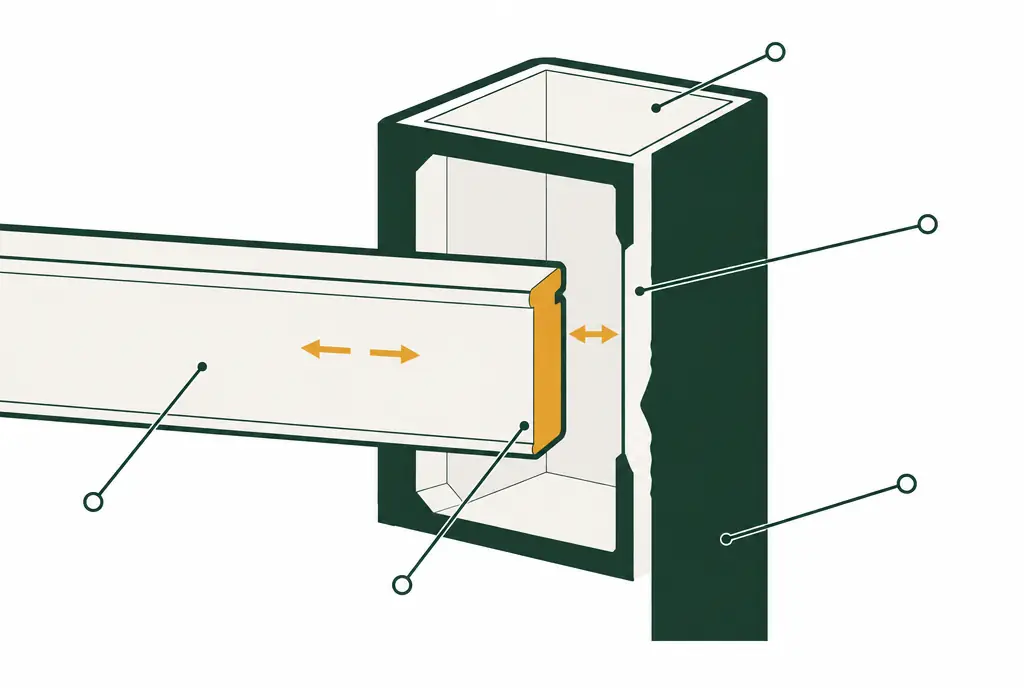
What the callout markers point to
- Vinyl grows and shrinks with temperature; a rail cut to the full inside width of the post would buckle in July.
- The gap is hidden inside the post, so the fence face shows nothing.
- Lock tabs hold the rail in place while still letting it slide a fraction.
Racking ranch rail down a Castaic grade
Ranch rail is the easiest vinyl fence to run on a slope. The routed holes in the posts are oversized vertically, so the rails tilt up to about 10–15 degrees to follow the grade while the posts stay plumb. Steeper banks in Val Verde or Sloan Canyon get a stepped layout with shorter 8 ft rails, or the posts are set closer. Footings stay at 24–30 inches in the decomposed granite and sandstone of the north valley; a rock auger comes out on about one in three Hasley Canyon jobs.
Vinyl ranch rail is built to give way under a leaning horse rather than to stop a running one.
Mesh, electric tape and other add-ons
A 2x4 inch welded wire or no-climb mesh zip-tied or clipped to the horse side keeps dogs, goats and foals in. A strand of electric tape on offset insulators along the top rail stops cribbing and leaning. For a 12–16 ft trailer entrance, a vinyl double gate on steel-reinforced 5x5 posts with a drop rod matches the fence; many ranch owners prefer a galvanized pipe gate in the same opening for strength, and the vinyl line ties into it cleanly.
Vinyl Ranch Rail Fence — common questions
How much is three-rail vinyl per foot?
About $20–$34 per linear foot installed in 2026 on a clear, augerable line; a 400 ft run lands roughly in the $8,000–$13,600 range before gates and rocky-soil adjustments.
Is vinyl ranch rail strong enough for cattle?
For a few head on a small lot, with the heavier 2x6 rail and 6 ft spacing, yes. For working cattle pens most ranchers go to pipe and use vinyl only on the perimeter and the street side.
Vinyl Ranch Rail Fence: check availability and price range
Bookings aren't open yet — describe the fence line and you get a Santa Clarita price range right here. Per-foot ranges are typical Santa Clarita Valley installed prices for white vinyl, materials and labor. This is a market estimate, not a quote; footage is measured on site and the installer prices the actual job. City permit fees and HOA fees, where they apply, are not included.