
How Deep Should Vinyl Fence Posts Be Set?
Santa Clarita Vinyl Fence explains how deep vinyl fence posts are set in Santa Clarita Valley yards — the one-third rule, why gate and corner posts go deeper, concrete and gravel in the hole, what the valley's clay, caliche and Santa Ana winds change, and how a shallow post shows itself.
Bookings aren't open yet. Leave your name and number; your message is recorded, and you'll get one message when a local installer is available.
The yard as it starts
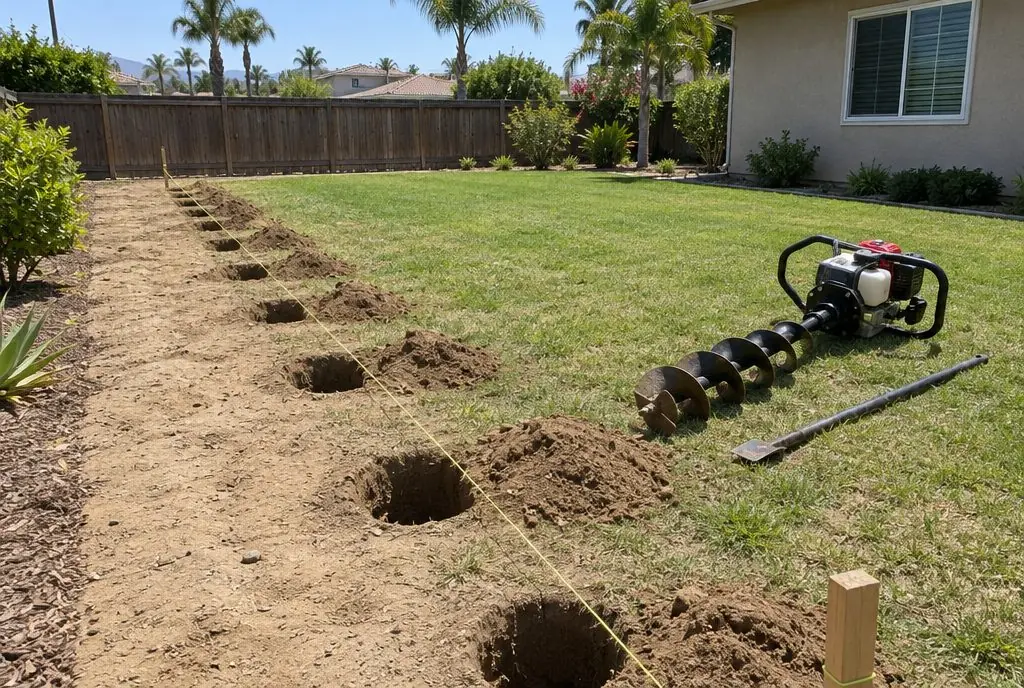 Illustration
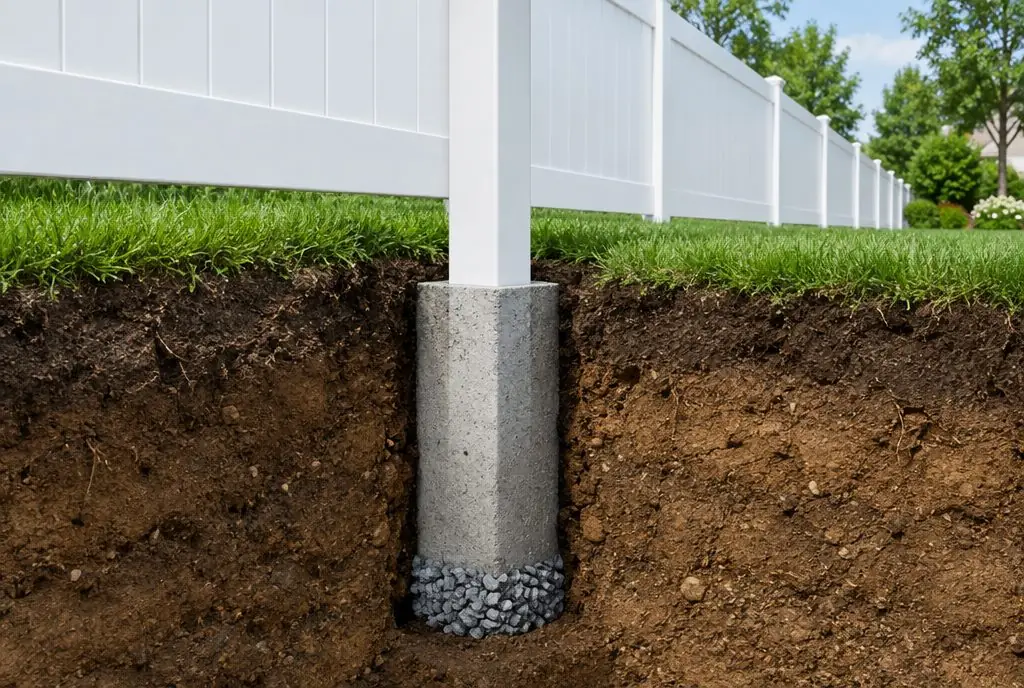
The finished fence (illustration)
 Illustration
The one-third rule, and what it means for a 6-foot fence
The working rule for a vinyl fence post is that about a third of the post goes into the ground. A 6-foot privacy fence uses a post around 9 feet long, so roughly 3 feet is buried; in practice line posts for a 6-foot fence are set in holes about 30 inches deep, which with the gravel base and the concrete puts the post at close to that third. A 3- or 4-foot picket fence uses a shorter post and a hole closer to 24 inches. Ranch-rail posts on a 4- or 5-foot fence sit between those.
The depth is about leverage, not weight. A vinyl panel is light, but a 6-foot solid panel is a sail, and the post is a lever with the ground as its pivot. The deeper the buried part, the less the wind and a leaning neighbor's trellis can rock it.
| Fence | Post size | Hole diameter | Typical hole depth |
|---|---|---|---|
| 3–4 ft picket | 4×4 in | about 8 in | about 24 in |
| 4–5 ft ranch rail | 5×5 in | about 10 in | about 30 in |
| 5 ft pool barrier style | 4×4 to 5×5 in | 8–10 in | about 30 in |
| 6 ft privacy or semi-privacy | 5×5 in | about 10 in | about 30 in |
| Walk gate or corner post | 5×5 in, reinforced at gates | about 12 in | about 36 in |
| Double drive gate post | 5×5 in, metal insert | about 12 in | about 42 in |
Gate and corner posts go deeper
Not every post carries the same load. A corner post takes rails from two directions and is the anchor the rest of the line pulls against. A gate post carries a swinging weight all day and is pushed sideways every time the gate is opened. End posts at a house wall or a block wall take the final rail with nothing beyond it. These posts are set deeper, often 36 inches for a walk gate or a corner and 42 inches for a double drive gate, in a wider hole with more concrete, and gate posts are reinforced with a metal insert so the hinges bear on steel rather than hollow vinyl.
Concrete, gravel and the hole itself
A vinyl post is hollow and has no bite in the soil the way a rough wood post does, so it is set in concrete. The hole is augered wider than the post — about 10 inches for a 5-by-5 — so there is a collar of concrete all the way around. A few inches of gravel at the bottom let water drain instead of sitting against the post, and the concrete is poured around the post and sloped away from it at grade so rain sheds off the footing.
Tamped dirt or gravel alone, which works for some wood and steel fences, is rarely enough for vinyl in this valley; a vinyl post set that way works loose within a few seasons. Fast-setting concrete lets the installer plumb the post, brace it, and move on, with the panels going in the next day.
A vinyl post holds because of the concrete around it, not because of the soil it touches.
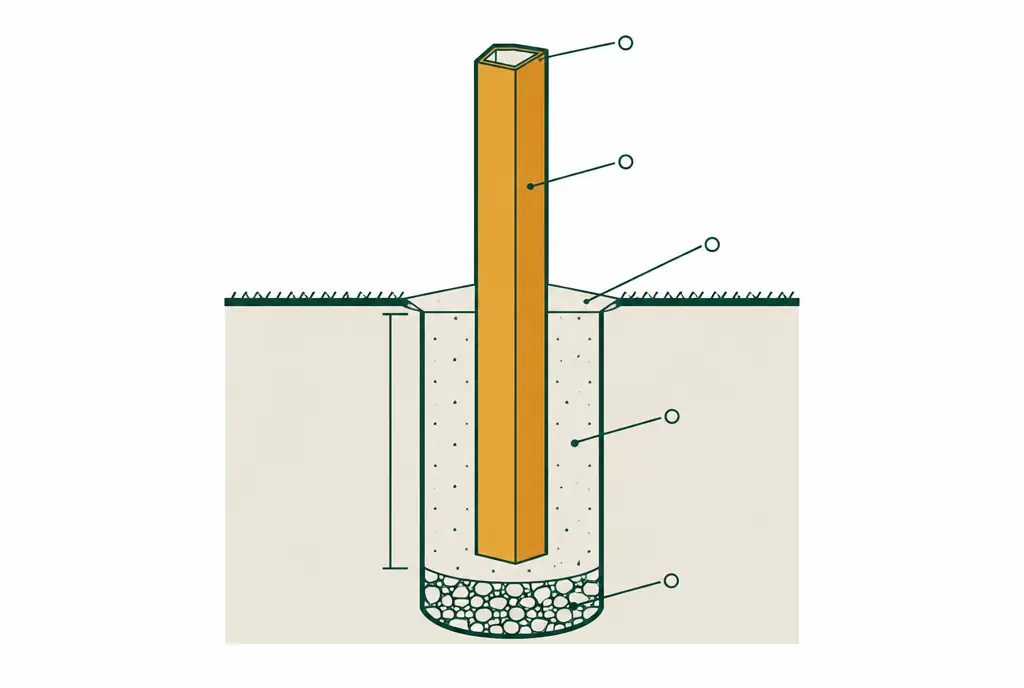
What the callout markers point to
- The hole is augered wider than the post so concrete surrounds it on every side.
- Gravel at the bottom lets water drain away from the hollow post instead of pooling.
- The top of the footing is sloped so rain sheds off instead of sitting against the vinyl.
Santa Clarita soil: sandy loam, clay and caliche
Flat yards in Saugus and Newhall tend to be sandy loam that digs easily and drains well, where the standard depth with gravel and concrete is straightforward. Clay, common on the Valencia and Stevenson Ranch pads, holds water and swells in winter, which can lift a shallow footing; the answer is full depth, a gravel base, and a concrete collar that extends above the clay layer. The hillside soils of Canyon Country, Castaic and Val Verde bring decomposed granite and caliche, a cemented layer that stops a hand auger cold. There the holes are opened with a machine auger and a rock bit, finished with a demolition hammer, and the extra time is what the rocky-ground rate in the estimator covers.
Wind, slopes and what a shallow post looks like
The Santa Ana winds that funnel through the valley every fall are the real test of a fence post. A privacy fence set at full depth in concrete rides them out; one set in short, narrow holes leans a little more each season until a panel pops its rail. On slopes the downhill side of a stepped panel puts extra lever on the post below it, which is one more reason hillside posts go the full depth and get the aluminum insert in the bottom rail to stiffen the bay.
A post set too shallow shows itself early: a top line that is no longer straight, caps that lean away from each other, a gate that drags on one side, and a footing that rocks when the post is pushed. Resetting a post means pulling it with its footing and starting over, which is why the depth is right the first time.
How post depth figures into the price
Depth is built into the per-foot rate rather than priced separately: the estimator on this page assumes posts at full depth in concrete for the style chosen, with corner and gate posts deeper. What changes the number is the ground — hard, rocky or caliche soil carries its own rate, and a slope carries another — and the gates, which bring their reinforced posts with them. The cost guide covers the rest, and entering the fence length and the soil condition shows the typical Santa Clarita Valley range for that fence.
Where this leads
- Service page: Vinyl Privacy Fence Installation — 6 ft solid tongue-and-groove panels on 5x5 posts in concrete, built for SCV wind. The most-requested fence in the valley.
- Local page: Vinyl fence installation in Saugus
- All services and typical prices: vinyl fence installation in Santa Clarita
- More illustrated guides: Fence Ideas & Guides
Check availability and the price range for this setup
Bookings aren't open yet — describe the fence line and you get a Santa Clarita price range right here. Per-foot ranges are typical Santa Clarita Valley installed prices for white vinyl, materials and labor. This is a market estimate, not a quote; footage is measured on site and the installer prices the actual job. City permit fees and HOA fees, where they apply, are not included.