
Santa Clarita Vinyl Fence: Dog Run and Side-Yard Vinyl Fencing in Santa Clarita
Santa Clarita Vinyl Fence covers dog run and side-yard enclosure installation for Santa Clarita Valley homes — closing off a side yard with a gate, building a dedicated run along the house, or tightening an existing fence so a dog cannot squeeze under or through it — where the installer sizes the height to the dog, holds the gaps under 2 inches and fits a gate that closes on its own.
 Illustration
Side-yard enclosures that actually contain a dog
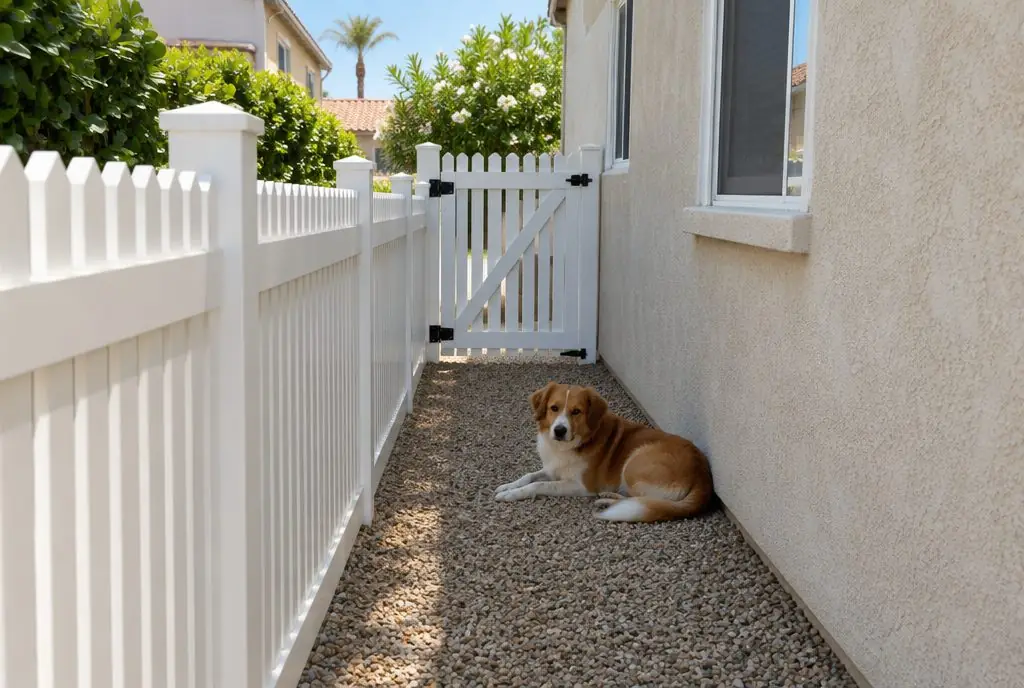
The typical SCV side yard is 5–8 ft wide between the house and the property-line fence, already fenced on three sides, open at the front and the back. Closing it takes two gates or one gate and a panel. For a run that doubles as the dog's outdoor space, a 6 ft privacy panel at the front keeps street noise and the mail carrier out of sight, and a 4–5 ft picket at the back keeps the dog in view from the kitchen. The weak points are always the gaps: under the gate, between the last panel and the stucco, and at the air conditioner pad.
The weak points of a dog run are always the gaps, not the panels.
Dig guards, gaps and bottom rails
Bottom rail at grade
The bottom rail is set within 2 inches of the ground along the whole run, which on an uneven side yard means trimmed pickets or a mow strip rather than a level rail floating 5 inches up at the low end.
Dig guard
For diggers, an L-shaped strip of 2x4 welded wire buried 6 inches down and 12 inches out along the inside of the fence, or a concrete mow curb poured under the bottom rail. Vinyl itself cannot be chewed through, but the ground under it can be dug.
Picket spacing
Under 2 inches for small breeds and puppies; standard 3 inch spacing is fine above 30 lbs. Privacy panels have no spacing to worry about but cut airflow in a narrow side yard in August.
Heights by breed and coyote reality
Four feet holds most dogs under 40 lbs; five feet is right for medium dogs and any jumper; six feet for large breeds, huskies and anything that has cleared a fence before. Coyotes come down from the open space in Castaic, Sand Canyon, Stevenson Ranch and the Canyon Country hills and clear 6 ft fences easily; a run that is left overnight gets a top or a coyote roller on the top rail. Vinyl's smooth face at least gives nothing to grip on the way up.
| Dog | Suggested height | Picket gap | Extras worth adding |
|---|---|---|---|
| Small breeds and puppies, under 20 lbs | 4 ft | Under 2 in | Bottom rail at grade |
| Medium dogs, 20–50 lbs | 5 ft | Standard 3 in is fine | Self-closing gate |
| Large breeds, jumpers, huskies | 6 ft | Privacy panel | Coyote roller if left out at night |
| Diggers of any size | Per size above | Per size above | Buried wire L-guard or a concrete mow curb |
Kennel pads, gravel and gates
Side yards in the valley are often compacted dirt that turns to mud under sprinklers and dust in summer. A 3/8 inch pea gravel or decomposed granite pad over weed fabric drains and cleans easily; artificial turf with a drainage base is the other common choice. The gate gets self-closing hinges and a latch at hand height that a dog cannot nose open — a gravity latch with a spring, not a plain hook — and a 48 inch width so the trash bins still roll through.
Dog Run & Side-Yard Enclosures — common questions
How much does fencing in a side yard cost?
A typical 20–30 ft of panel plus one 48 inch gate lands roughly between $1,200 and $2,300 installed in 2026, depending on privacy versus picket and whether a dig guard is added.
Will the dog chew vinyl?
Vinyl is harder and less satisfying to chew than wood and has no splinters; determined chewers scar it but rarely get through. The bottom rail is the usual target, and a mow curb under it removes the temptation.
Dog Run & Side-Yard Enclosures: check availability and price range
Bookings aren't open yet — describe the fence line and you get a Santa Clarita price range right here. Per-foot ranges are typical Santa Clarita Valley installed prices for white vinyl, materials and labor. This is a market estimate, not a quote; footage is measured on site and the installer prices the actual job. City permit fees and HOA fees, where they apply, are not included.