
Santa Clarita Vinyl Fence: Project example: 90 feet of 5-foot climb-resistant pool fence with a self-closing, self-latching gate in Valencia — what it looks like and what it costs
Santa Clarita Vinyl Fence sets out a typical pool-barrier project for a two-story Valencia tract home from the newer neighborhoods: 90 linear feet of 5-foot white vinyl picket-style pool fence built to California's residential pool barrier rules, running from the house wall around the pool deck and back, with one 4-foot self-closing, self-latching gate that swings away from the water.
Project Examples & Typical Prices
Worked example. The pictures are AI concept illustrations, not photographs; no installation was performed or arranged through this site; prices are typical Santa Clarita Valley market ranges, not quotes.
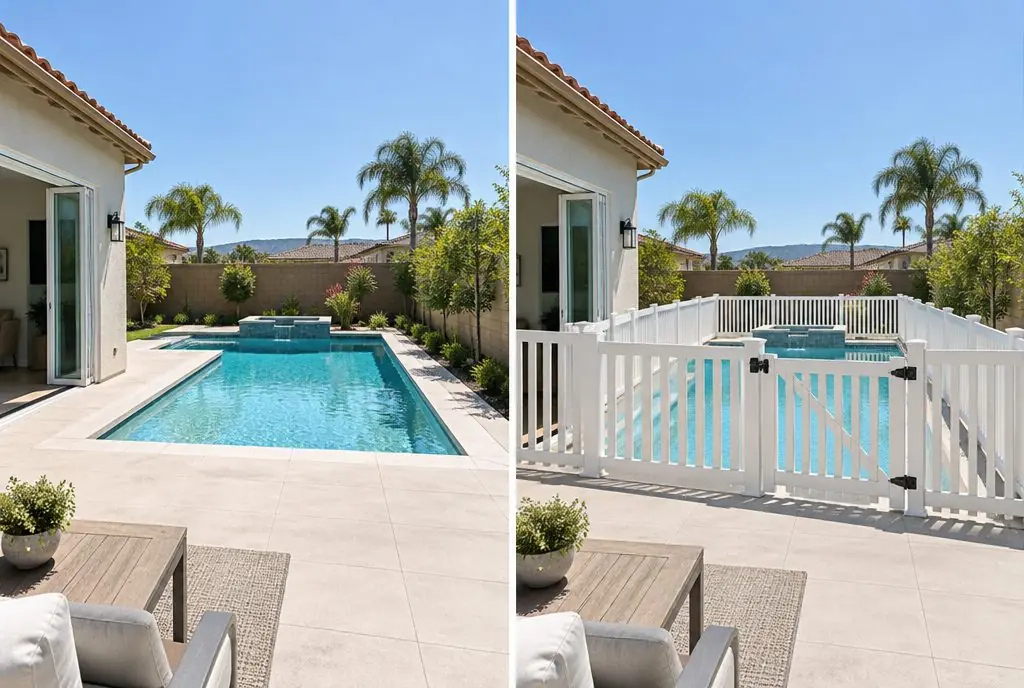 Illustration
Starting pointFinished layout (concept)
Illustration
Starting pointFinished layout (concept)
The scenario
The yard belongs to a two-story tract home in one of Valencia's newer planned neighborhoods: a 6-foot block wall already encloses the lot on three sides, and a newly finished pool and spa sit about 15 feet from the sliding doors of the family room. The pool contractor has left the deck and the lawn in place, but there is no barrier between the house doors and the water, which is what the county's pool safety inspection looks for before the pool can be signed off. The yard is flat and the fence line runs across lawn and along the edge of the concrete deck.
The brief is an isolation fence built to the Pool Safety Act dimensions: 5 feet tall, no gaps a 4-inch ball could pass through, nothing a small child could climb, and a gate that closes and latches on its own with the release up high on the pool side. The route runs 90 feet from the house wall around the far side of the lawn and back to the block wall, keeping the pool deck inside and a strip of lawn outside, with the gate on the lawn side nearest the patio. White vinyl is chosen to match the house trim and because the pool inspector sees the same spacing on every panel.
The barrier dimensions the layout is drawn around:
- Height: at least 60 inches from grade on the outside of the fence
- Bottom clearance: no more than 2 inches under the bottom rail
- Openings: under 4 inches between pickets
- Gate: self-closing and self-latching, swinging away from the pool, release at least 60 inches above grade
- Footholds: no horizontal members a child could use to climb
What the job involves
- The installer reviews the pool barrier requirements that apply to a new residential pool in the county, confirms the 60-inch minimum height and the 4-inch gap limit, and sketches the route so the barrier fully separates the sliding doors from the water.
- The line is marked with paint on the lawn and tape on the deck, post centers are set at 6-foot spacing to keep the pickets from flexing, and the gate opening is placed where the latch will be reachable by adults from the lawn side but out of a child's reach.
- Holes are augered 30 inches deep in the lawn; where the line crosses the concrete deck, a core drill cuts clean holes and the posts there are set in concrete inside the cored opening.
- Posts are set and plumbed to a string line, and the bottom rail is held so its underside sits no more than 2 inches above grade and deck, with the picket spacing checked against a 4-inch gauge block before the top rail goes on.
- The gate is hung on a reinforced post with spring-loaded self-closing hinges, the gravity latch is mounted on the pool side at the required height above grade, and the gate is adjusted to swing outward away from the pool and latch from any open position.
- A final walk-through checks every gap, the ball-pass test at the bottom and between pickets, the latch height, and that no planter, chair or spa equipment sits where it could be used as a step; the deck and lawn are cleaned.
Hardware and materials
- 4-by-4 inch white vinyl posts routed for a 5-foot picket panel, with a reinforced 5-by-5 gate post
- Pool-style picket panels with 2-by-3.5 inch rails and 1.5-inch square pickets spaced under 4 inches, no horizontal members between rails that could serve as a foothold
- One 4-foot vinyl gate with a welded frame, spring-loaded self-closing hinges and a magnetic or gravity pool latch mounted at least 60 inches above grade, as the Pool Safety Act describes
- Core drill and diamond bit for the deck crossings, auger for the lawn holes, concrete and gravel
- 4-inch ball gauge, string line, post levels, braces and vinyl-safe adhesive for caps
- Flat caps for every post
What it typically costs in the Santa Clarita Valley
| Pool code fence (5 ft, climb-resistant), 90 linear feet installed ($40–$60 per foot) | $3,600–$5,400 |
| Single walk gate (4 ft) | +$350–$650 |
| Typical total | $3,950–$6,050 (market range, not a quote) |
These are typical local ranges, not a quote or an offer; an installer prices the actual job after seeing the wall.
Add-ons often paired with this job
- Double drive gate (10–12 ft) — +$1,100–$2,200. A removable double section or a wide double gate lets pool-cleaning equipment or furniture pass through, priced on top of the walk gate.
- Decorative post caps (per run) — +$60–$180. Decorative caps on a short pool run are a low-cost touch; they do not change the barrier's compliance.
- HOA submittal package — +$100–$250. Some planned communities ask for a fence plan when a pool barrier is visible from a side street; a submittal package is a separate line.
Why it is done this way
A pool barrier is the one vinyl fence where the layout is dictated by rules rather than taste. California's residential pool safety rules call for a barrier at least 60 inches high, no openings a 4-inch sphere can pass through, a bottom clearance of 2 inches or less, and a gate that is self-closing, self-latching, opens away from the pool and has its release up high on the pool side. Every step above exists to satisfy one of those lines, which is why the posts sit closer together than on a privacy fence and why the picket spacing is checked with a gauge rather than by eye.
Vinyl picket is a good fit for a barrier because its square pickets leave no horizontal foothold, it does not rust around a pool, and the panel geometry is the same from the first post to the last. The deck crossings are cored rather than surface-mounted because a bolted base plate on a pool deck is both weaker and more likely to work loose.
Why the gauge block and not a tape measure:
- a tape shows the gap at one point, while the 4-inch gauge confirms it along the whole picket
- the bottom clearance changes where lawn meets deck, so it is checked at every bay
- the latch height is measured from the grade where a child would stand, not from the deck
What would change the price
- The route has to cross more concrete deck — each cored post hole costs more than an augered one in lawn.
- The sliding doors need an alarm or self-closing device as a second barrier layer — that is a door hardware item, not part of the fence.
- The brief calls for a 6-foot barrier for privacy as well — taller panels and 5-by-5 posts move the base rate up.
- A second gate on the far side for the pool service — each additional self-closing gate is its own option.
- The inspection calls for changes after the fence is built — moving a gate or closing a gap at the house wall adds a return trip.
Where this leads
- Service page: Vinyl Pool Fence (Pool Code Barrier) — 5 ft climb-resistant vinyl barrier with self-closing gate and magnetic latch, built to the California Pool Safety Act dimensions.
- Local page: Vinyl fence installation in Valencia
- All services and typical prices: vinyl fence installation in Santa Clarita
- More worked examples: Project Examples & Typical Prices
Check availability and the price range for this setup
Bookings aren't open yet — describe the fence line and you get a Santa Clarita price range right here. Per-foot ranges are typical Santa Clarita Valley installed prices for white vinyl, materials and labor. This is a market estimate, not a quote; footage is measured on site and the installer prices the actual job. City permit fees and HOA fees, where they apply, are not included.