
Santa Clarita Vinyl Fence: HOA and Community Perimeter Vinyl Fencing in Santa Clarita
Santa Clarita Vinyl Fence covers association-owned vinyl fencing for Santa Clarita Valley communities — tract perimeter walls and fences, greenbelt and paseo fencing, slope-top fencing behind rows of homes, and pool and park enclosures — where the project is specified for a board, phased over a reserve-study schedule and installed with homeowners informed at each step.
 Illustration
Perimeter and common-area fencing for associations
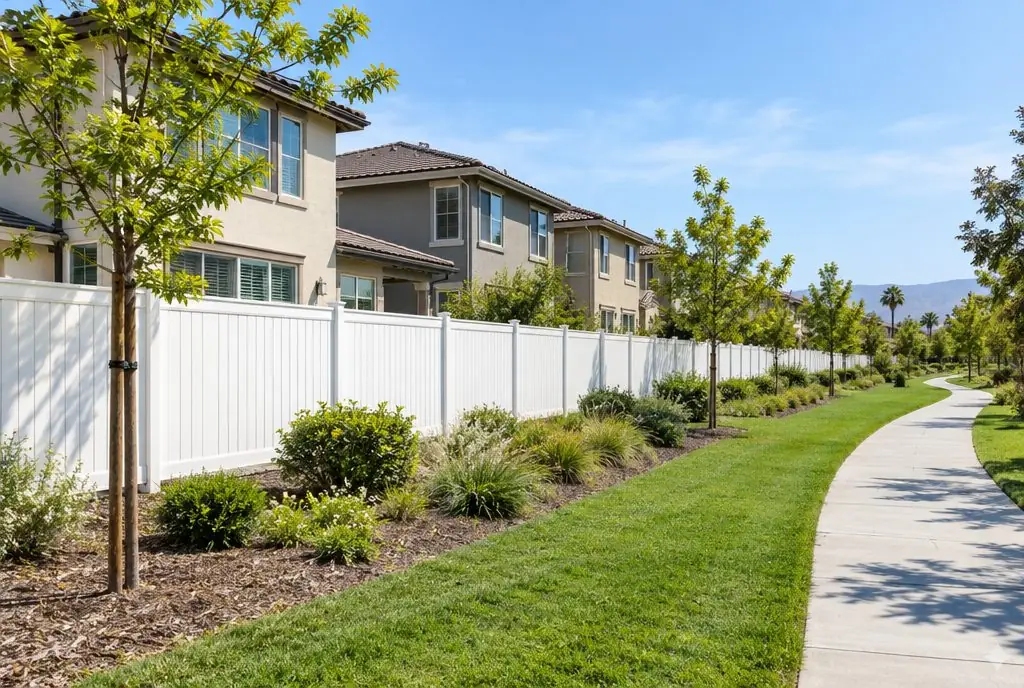
Valencia's paseos, the greenbelts of Stevenson Ranch, the slope-top fencing behind entire streets in Fair Oaks Ranch and Copper Hill — these runs belong to the association, not the homeowners, and they were installed by the builder all at once. They age all at once too, and the board faces a few thousand feet of fence rather than a backyard. The scope usually mixes vinyl privacy on lot-facing sections with open tubular steel on view sections, and the replacement has to respect the community's own design guidelines as closely as any homeowner's fence.
Phasing a multi-year replacement
| Condition score | What the survey finds | Typical action | Typical timing |
|---|---|---|---|
| 1 — Sound | Plumb posts, clean panels, gates closing | Wash and spot-check | Next survey |
| 2 — Cosmetic | Chalking, mildew, loose caps | Clean, re-cap, replace odd pickets | Maintenance budget |
| 3 — Local failure | Popped rails, a few leaning posts, sagging gates | Repair the section | Within the year |
| 4 — Failing run | Brittle sun-side panels, cracked posts along the run | Replace the run | Current reserve phase |
Condition survey first
Every run is walked and scored — posts, rails, pickets, gates — so the worst sections go first and sound sections wait a budget cycle.
Phases by street or by exposure
Sun-facing and wind-facing runs fail first. Phases are drawn so each year's work is a complete visual unit, not a patchwork, and so access through the greenbelt stays open.
Consistent specification
One profile, one color, one cap and one post spec across all phases, written into the bid so phase three matches phase one even with a different crew.
Bid packages, reserve studies and warranties
Boards and managers need a package they can compare: linear feet by run and style, posts and spacing, concrete per post, gate schedule, removal and disposal, traffic control where a run faces a street, and a unit price per foot for additions. The numbers are tied to the reserve study's fence component so the board can see whether the funded amount covers the scope. Most vinyl fence manufacturers offer a limited warranty on the material (terms, length and transferability vary by brand); a workmanship warranty, if any, is the installer's and is published before bookings open.
Keeping homeowners informed during the work
Fence replacement behind someone's backyard is disruptive: the old fence comes down, strangers are in the slope easement, and the dog has to stay in. Notices go out by street a week ahead with dates, hours and a contact; gates in the rear line are coordinated per lot; and the crew that is booked keeps each lot's section closed by the end of the day with temporary panels where the new fence is not yet up. Managers get a daily progress note so the board hears about it before the homeowners complain.
A community fence program succeeds when the board hears about the work before the homeowners complain about it.
HOA & Community Perimeter Fencing — common questions
Who pays for perimeter fence replacement in an HOA?
The association, from reserves, when the fence is an association component under the CC&Rs; side fences between two homes are usually the homeowners'. The governing documents and the reserve study say which is which.
How is a community perimeter project priced?
By linear foot and style per run, with gates, removal, traffic control and phasing itemized, so the board can award one phase at a time or the whole program.
HOA & Community Perimeter Fencing: check availability and price range
Bookings aren't open yet — describe the fence line and you get a Santa Clarita price range right here. Per-foot ranges are typical Santa Clarita Valley installed prices for white vinyl, materials and labor. This is a market estimate, not a quote; footage is measured on site and the installer prices the actual job. City permit fees and HOA fees, where they apply, are not included.