
Can You Install a Vinyl Fence on a Slope?
Santa Clarita Vinyl Fence explains how a vinyl fence is built on the sloped lots common across Canyon Country, Val Verde and the hillside edges of Santa Clarita — stepped versus racked panels, how the choice is made, and what the grade does to the posts, the gaps and the price.
Bookings aren't open yet. Leave your name and number; your message is recorded, and you'll get one message when a local installer is available.
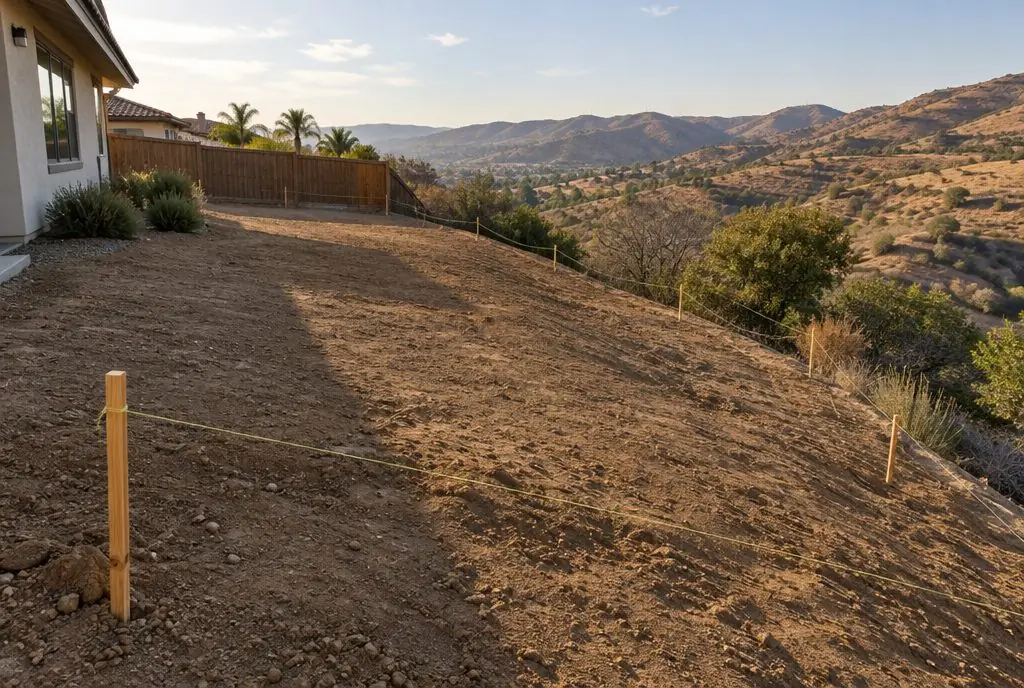
The yard as it starts
 Illustration
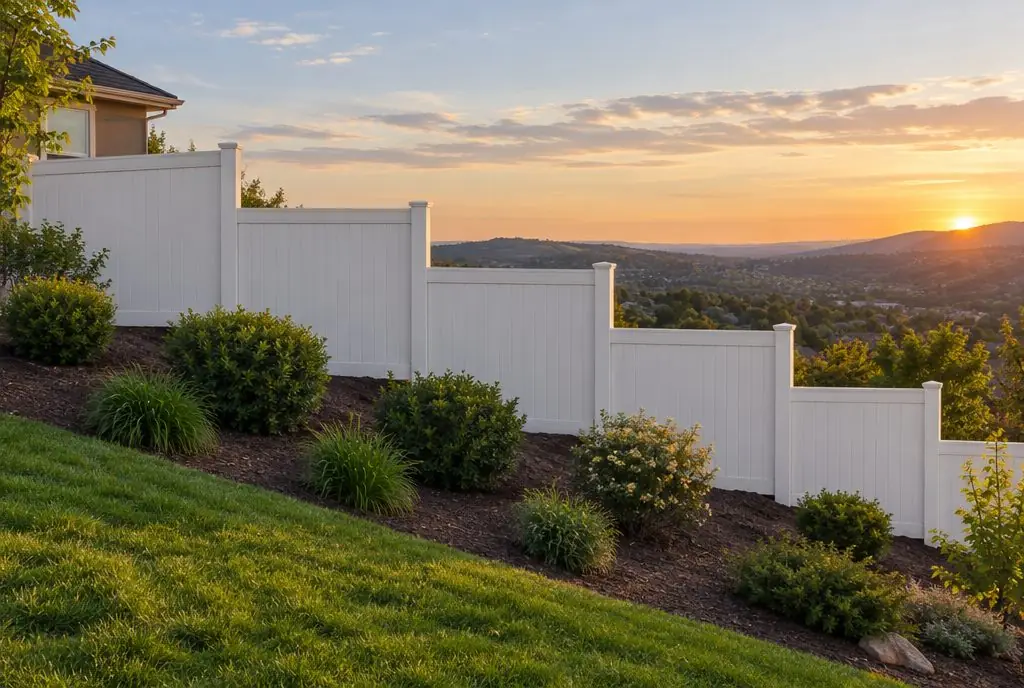
The finished fence (illustration)
 Illustration
Yes — the question is stepped or racked
A vinyl fence goes on almost any slope a homeowner would want fenced, and the sloped lots along the canyons of Canyon Country, the ridges of Val Verde and the hillside edges of Saugus are fenced with vinyl every season. What changes on a slope is not whether the fence can be built but how the panels deal with the grade. There are two methods: stepping, where every panel stays level and each one drops a fixed amount below the last, and racking, where the rails tilt to follow the ground while the pickets stay plumb.
Both produce a sound fence. The choice depends on how steep the grade is, what style of panel is being used and how the top line should look from the house.
| Method | Panel styles | Top line | Gaps at the bottom | Relative cost |
|---|---|---|---|---|
| Stepped | solid privacy, most standard panels | a staircase of level sections | triangles under each downhill end | more posts and kick boards |
| Racked | picket, ranch rail, semi-privacy, rackable privacy | one continuous slope | none, the rails follow the grade | rackable material costs more |
| Mixed | any rackable style | continuous where gentle, stepped where steep | only at the stepped bays | depends on the split |
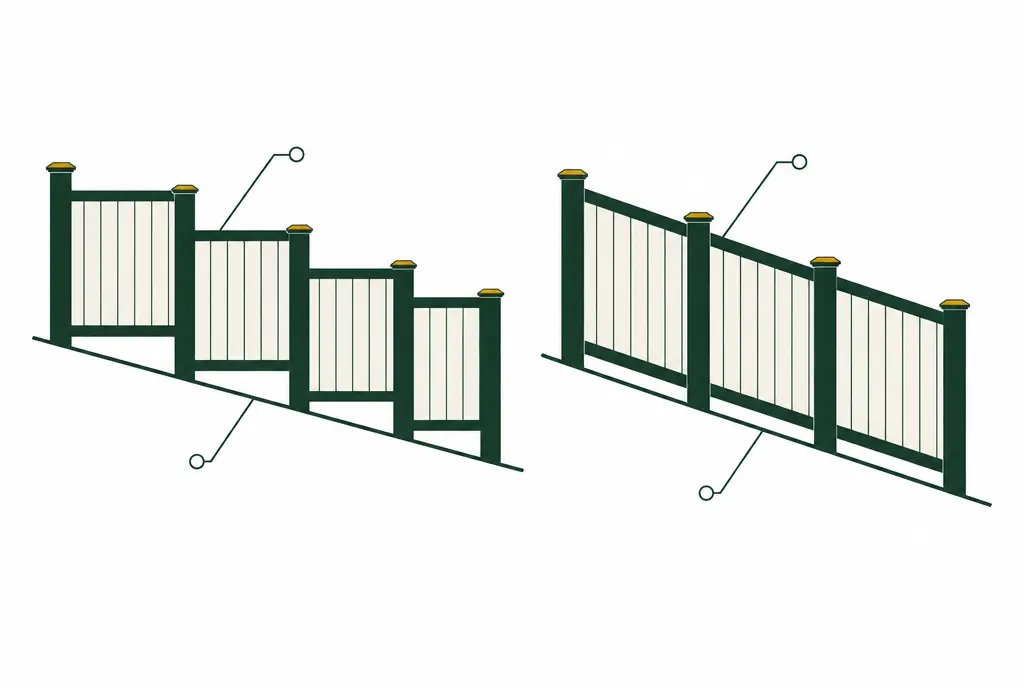
What the callout markers point to
- Stepped: every panel stays level and each post drops by the same amount; triangular gaps are closed with a kick board.
- Racked: the rails tilt to follow the ground, the pickets stay vertical, and the top line runs continuous.
- Each panel has a racking limit; beyond it the installer steps instead.
Stepped panels: level sections down a staircase
Stepping is the method for solid privacy fences. Tongue-and-groove pickets lock into each other and cannot tilt inside their rails, so a privacy panel is a rigid rectangle. On a slope it is set level, and the next panel is set one step lower. The installer measures the total fall along the run with a laser level and divides it by the number of panels, so every step is the same height and the top line reads as a clean staircase rather than a random zigzag.
The trade-off is the triangle of open space under the downhill end of each panel. On a gentle grade that gap is a couple of inches and reads as a shadow line; on a steeper one it grows, and a kick board, a strip of vinyl or a row of blocks closes it so a dog cannot slip under.
Racked panels: the fence follows the ground
Racking suits picket, ranch-rail and semi-privacy panels, and privacy panels made specifically as rackable. The posts are routed at an angle, the rails run parallel to the slope and the pickets stay vertical, so the bottom of the fence hugs the grade with no triangles and the top line is one continuous slope. From a patio looking down a yard, a racked fence looks like it grew there.
Each product has a rackable limit, usually expressed as inches of rise per 8-foot panel. Within that limit the panel simply tilts; beyond it the pickets bind in the rails and the installer either switches to stepping or orders a custom panel. Rackable privacy panels cost more as material than standard ones, which shows up in the slope rate.
How the installer decides
The decision begins with a level. The installer shoots the grade along the whole line and works out the rise per panel. A gentle, steady slope within the rackable range on an open-style fence is racked. A steady slope with a solid privacy fence is stepped in equal drops. A yard that is flat near the house and falls off sharply at one corner, which is common on cut-and-fill tract pads, is often racked where it is gentle and stepped only at the steep bays.
Corners and gates are planned first, because a gate needs level ground to swing and a corner post should sit where the grade is firm. Everything else is laid out from those fixed points.
On a slope, the corners and the gates are placed first, and every other post is laid out from them.
Posts, concrete and wind on a hillside
Hillside soil is rarely the easy sandy loam of a flat tract yard. Decomposed granite over clay, or caliche layers, mean post holes take longer and sometimes need a bar or a demolition hammer to reach depth. The depth matters more on a slope: a post set shallow on the downhill side of a step carries more lever from the panel, and a 6-foot privacy panel presents a full sail to the Santa Ana winds that pour through the canyons every fall. Posts go the full depth, in concrete, with gravel at the bottom for drainage so winter runoff down the slope does not pool around them.
The aluminum insert in the bottom rail of a privacy panel is not optional on a hillside. It keeps the rail from sagging across an 8-foot bay in summer heat and stiffens the whole fence against wind.
What a slope does to the price
A sloped line costs more per foot than a flat one, and the estimator on this page carries a separate rate for it. The extra covers the layout time with a level, longer posts at the steps, more posts where bays are shortened, the kick boards that close the gaps, and the rackable material where the fence follows the grade. The cost guide walks through the other factors. Entering the length and the slope condition in the estimator shows the typical Santa Clarita Valley range for a hillside fence of a given style, and a walk of the line with an installer turns that range into a quote.
Where this leads
- Service page: Vinyl Fence on a Slope (Stepped & Racked) — Stepped privacy panels or racked rail fences for hillside side yards and pad edges, with the bottom gap handled.
- Local page: Vinyl fence installation in Canyon Country
- All services and typical prices: vinyl fence installation in Santa Clarita
- More illustrated guides: Fence Ideas & Guides
Check availability and the price range for this setup
Bookings aren't open yet — describe the fence line and you get a Santa Clarita price range right here. Per-foot ranges are typical Santa Clarita Valley installed prices for white vinyl, materials and labor. This is a market estimate, not a quote; footage is measured on site and the installer prices the actual job. City permit fees and HOA fees, where they apply, are not included.