
Santa Clarita Vinyl Fence: Project example: a 3-foot white vinyl picket fence across a Stevenson Ranch front yard, approved through the association first — what it looks like and what it costs
Santa Clarita Vinyl Fence walks through a typical front-yard project in a Stevenson Ranch planned community: 60 linear feet of 3-foot white vinyl picket fence along the sidewalk edge of the lawn and back along one side to the garage, with a walk gate at the front path, submitted to the association's design review committee and approved before the first post hole is dug.
Project Examples & Typical Prices
Worked example. The pictures are AI concept illustrations, not photographs; no installation was performed or arranged through this site; prices are typical Santa Clarita Valley market ranges, not quotes.
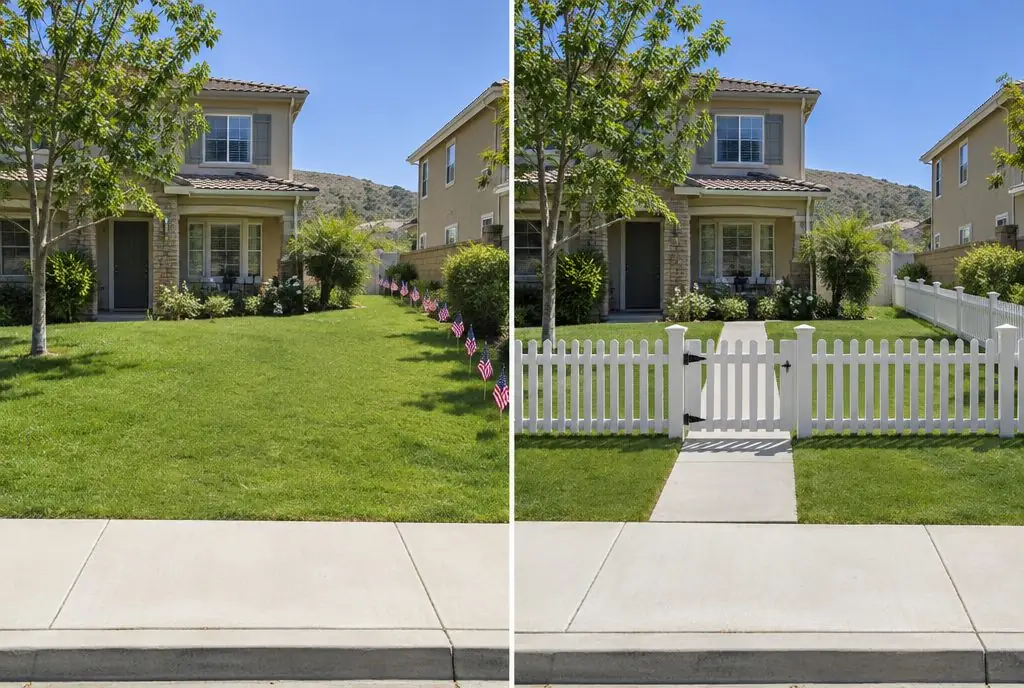 Illustration
Starting pointFinished layout (concept)
Illustration
Starting pointFinished layout (concept)
The scenario
The home is a two-story stucco house in one of the Stevenson Ranch neighborhoods where every exterior change passes through an architectural review committee. The front lawn is about 40 feet wide along the sidewalk and runs 20 feet back along one side to the garage wall; the other side is shared with a neighbor's driveway and stays open. A concrete path leads from the sidewalk to the porch. There is no fence now, and the brief calls for a low picket fence to keep a dog on the lawn and give the entry some definition without blocking the view of the house.
The brief is a 3-foot white vinyl picket fence with a 4-foot gate at the path, a style and height the community's guidelines allow in a front yard once approved. Front-yard fences in these neighborhoods typically have a height cap, a required setback from the sidewalk, rules about color and picket style, and sometimes a requirement that the fence stay inside the planting strip. The project therefore starts at a desk: a site sketch, a product sheet, and a color sample go to the committee, and the posts go in only after the approval letter arrives.
What the submittal package carries to the committee:
- A plot sketch with the fence line, its setback from the sidewalk and the gate at the path
- The manufacturer's spec sheet with the 3-foot height and picket style called out
- A white color sample and the cap style
- The association's own application form
What the job involves
- The installer measures the lot, pulls the community's fence guidelines, and drafts a plot sketch showing the fence line set back from the sidewalk by the required distance, the gate at the path, and the height and picket spacing; the sketch, a manufacturer's spec sheet and a white color sample go into the design review submittal.
- After the approval letter is in hand, the line is marked with flags and paint on the lawn, utility marking is requested because front yards carry water, gas and irrigation lines, and the sprinkler heads near the sidewalk are flagged.
- Post centers are laid out at 8-foot spacing from the gate posts outward, so the gate lands squarely on the path and any short end panel falls at the garage wall rather than at the street corner.
- Holes are augered about 8 inches wide and 24 inches deep for the 4-by-4 posts of a 3-foot fence, with the two gate posts going deeper; the clay under the lawn is broken up with a bar and each hole gets a gravel base.
- Posts are set in concrete to a string line and plumbed; the next day the routed rails and pickets are assembled panel by panel, the gate is hung on adjustable hinges with a gravity latch, and the picket tops are checked for a dead-level line along the sidewalk.
- Caps are glued on, the lawn is patched at each hole, concrete spoil is hauled off, and the homeowner keeps the approval letter and the spec sheet for the association's records.
Hardware and materials
- 4-by-4 inch white vinyl posts routed for a 3-foot picket panel, with reinforced gate posts
- Picket panels with 2-by-3.5 inch rails and 1.5-inch pickets, dog-ear or pointed tops as the guidelines allow, in 8-foot sections
- One 4-foot vinyl walk gate with a welded frame, adjustable hinges and a gravity latch
- Auger with an 8-inch bit, digging bar, concrete, gravel, string line, post levels and braces
- New England or pyramid caps as specified in the submittal, with vinyl-safe adhesive
- A printed submittal set: plot sketch, product sheet, color sample
What it typically costs in the Santa Clarita Valley
| 3–4 ft picket, 60 linear feet installed ($28–$44 per foot) | $1,680–$2,640 |
| Single walk gate (4 ft) | +$350–$650 |
| HOA submittal package | +$100–$250 |
| Typical total | $2,130–$3,540 (market range, not a quote) |
These are typical local ranges, not a quote or an offer; an installer prices the actual job after seeing the wall.
Add-ons often paired with this job
- Decorative post caps (per run) — +$60–$180. Decorative caps are often the one place the guidelines allow a personal touch on a front fence; the style goes into the submittal.
- Tan, gray or woodgrain vinyl instead of white — +$300–$900. Where the guidelines call for a tan or almond fence to match the house trim, the colored material is a surcharge over white.
- Double drive gate (10–12 ft) — +$1,100–$2,200. A wider double gate across a side-yard driveway apron is sometimes added so a trailer can pass; it needs its own line in the submittal.
Why it is done this way
In a managed community, the sequence is the whole project: approval first, fence second. Building before the letter arrives risks a notice to remove the fence, and a fence that is a few inches too tall or set too close to the sidewalk can fail a later compliance walk. The submittal package is priced as its own item because preparing the sketch and specification takes time whether the fence is 60 feet or 160 feet long.
A 3-foot picket fence is light, so the posts can be 4-by-4 and the holes shallower than on a privacy fence, but front-yard fences are still set in concrete because lawn irrigation keeps the soil soft and a picket fence that leans even slightly is obvious from the street. White vinyl is the default choice here because it is the color most front-yard guidelines name, it needs no paint, and the picket spacing stays even for the life of the fence.
What a 3-foot front fence changes compared with a backyard privacy fence:
- Posts: 4-by-4 instead of 5-by-5, because the panel is short and open
- Holes: shallower, about 24 inches, with deeper gate posts
- Tolerance: smaller, because a lean or a wavy top line is visible from the street
What would change the price
- The committee requests a design change — a different picket top, a lower height or a larger setback — which means a revised submittal and sometimes different material.
- The gate moves to the driveway side — a wider or taller gate for a car or trailer changes the gate line and the post reinforcement.
- Irrigation lines run along the sidewalk and a lateral is cut — repair is a separate item.
- The fence continues down the shared side to the backyard — more feet at the same rate, but a change from 3-foot picket to 6-foot privacy at the house corner moves part of the run to a different base rate.
- The brief changes to a 4-foot picket instead of 3 — the same per-foot tier applies, but taller posts and longer pickets raise the material slightly.
Where this leads
- Service page: Vinyl Fence Through HOA Design Review — The association's listed profile, color and height, with the architectural submittal package prepared; approval is the HOA's decision.
- Local page: Vinyl fence installation in Stevenson Ranch
- All services and typical prices: vinyl fence installation in Santa Clarita
- More worked examples: Project Examples & Typical Prices
Check availability and the price range for this setup
Bookings aren't open yet — describe the fence line and you get a Santa Clarita price range right here. Per-foot ranges are typical Santa Clarita Valley installed prices for white vinyl, materials and labor. This is a market estimate, not a quote; footage is measured on site and the installer prices the actual job. City permit fees and HOA fees, where they apply, are not included.