
Santa Clarita Vinyl Fence: Project example: 400 feet of 3-rail white vinyl ranch fence around a Castaic paddock, posts set in rocky ground, with a 12-foot double gate — what it looks like and what it costs
Santa Clarita Vinyl Fence takes a typical paddock project on a horse property in the Castaic hills: 400 linear feet of 3-rail white vinyl ranch fence enclosing a flat turnout area beside a barn, with post holes drilled through rocky, caliche-bearing ground and a 12-foot double drive gate at the driveway end sized for a horse trailer.
Project Examples & Typical Prices
Worked example. The pictures are AI concept illustrations, not photographs; no installation was performed or arranged through this site; prices are typical Santa Clarita Valley market ranges, not quotes.
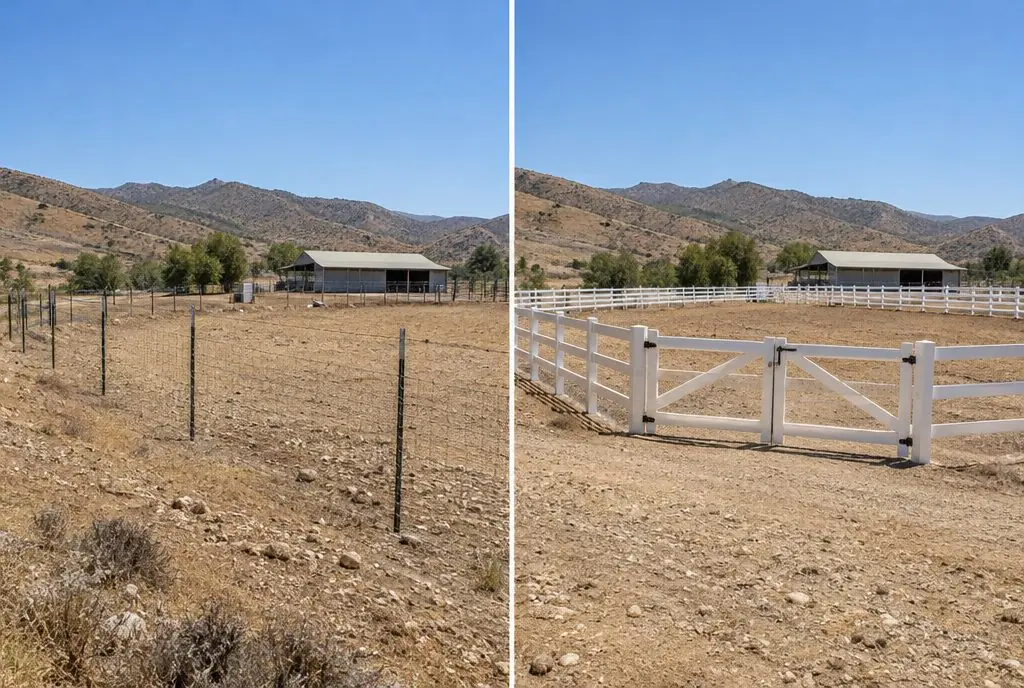 Illustration
Starting pointFinished layout (concept)
Illustration
Starting pointFinished layout (concept)
The scenario
The property is a few acres on a ridge north of Castaic Lake, the kind of parcel zoned for horses where a barn, a hay shed and a flat graded turnout sit beside the house. The turnout is roughly 100 feet by 100 feet, currently enclosed by a tired wire fence on steel T-posts that a horse has leaned through more than once. The ground is the Castaic mix of decomposed rock, hard clay and layers of caliche a foot or two down, which turns an ordinary post hole into a drilling job. The driveway reaches the paddock on one side, and that is where a trailer needs to pass.
The brief is a 3-rail white vinyl ranch fence around all four sides, about 400 linear feet, with a 12-foot double drive gate at the driveway for the trailer and the tractor. The brief calls for the fence to be horse-safe — no sharp edges, rails that give under a push rather than splinter — and visible from the house. Vinyl ranch rail is a natural fit for this: the rails flex and pop out of the post rather than breaking a leg, and the white reads clearly against the hillside for a horse at a run.
The site at a glance:
- Paddock: roughly 100 by 100 feet, flat and graded, beside a barn
- Existing fence: wire on steel T-posts, leaned through more than once
- Ground: decomposed rock and hard clay over caliche a foot or two down
- Access: the driveway meets one side, where a trailer has to pass
- Drainage: a swale beside the barn that the fence line must not block
What the job involves
- The installer walks the paddock to set the exact corners, flags the line with the barn's drainage swale in mind so the fence does not dam runoff, and arranges utility marking; the old wire and T-posts are pulled and stacked for scrap.
- Post centers are marked every 8 feet, with the double gate opening laid out first on the driveway side so the two gate posts land on firm ground and the 12-foot clear opening lines up with the driveway.
- A skid-steer or tractor-mounted auger with a rock bit opens the holes; where caliche stops the bit, a demolition hammer with a spade breaks the layer so each hole reaches about 30 inches for line posts and 36 to 42 inches for the gate and corner posts.
- The 5-by-5 posts are set in concrete and plumbed to a long string line; on a run this long the installer sights down each side to keep the posts in a straight plane across small dips in the grade.
- After the concrete cures, the 2-by-6 rails are threaded through the routed post holes three to a bay, with the rail ends meeting inside the posts and a small expansion gap left so summer heat does not buckle them; corner posts are routed on two faces.
- The two 6-foot gate leaves are hung on steel-reinforced gate posts with heavy-duty hinges, a drop rod on one leaf seats into a sleeve set in a concrete pad, and a latch bar joins the leaves; the gate is checked to swing clear of the grade and the driveway crown.
- Caps are glued on all 50-odd posts, the rock spoil is spread or hauled as requested, and the paddock is checked for leftover wire, nails and anything a hoof could find.
Hardware and materials
- 5-by-5 inch white vinyl ranch posts, routed for three 2-by-6 inch rails, about 50 line posts plus corner and gate posts
- 2-by-6 inch ribbed vinyl rails in 8-foot lengths, three per bay, with internal rail-to-post lock tabs
- A 12-foot double drive gate as two 6-foot welded-frame leaves, steel-reinforced gate posts, heavy-duty adjustable hinges, drop rod with ground sleeve, and a two-leaf latch
- Tractor or skid-steer auger with a rock bit, demolition hammer with a spade bit, digging bars, concrete and gravel for every hole
- Long string line, post levels, braces, and a concrete pad form for the drop-rod sleeve
- Flat caps, vinyl-safe adhesive, and a magnet sweeper for the paddock
What it typically costs in the Santa Clarita Valley
| Ranch rail (2–3 rail), 400 linear feet installed ($20–$34 per foot) | $8,000–$13,600 |
| Hard, rocky or caliche soil (+$3–$7 per foot) | +$1,200–$2,800 |
| Double drive gate (10–12 ft) | +$1,100–$2,200 |
| Typical total | $10,300–$18,600 (market range, not a quote) |
These are typical local ranges, not a quote or an offer; an installer prices the actual job after seeing the wall.
Add-ons often paired with this job
- Single walk gate (4 ft) — +$350–$650. A separate 4-foot walk gate beside the double gate lets a person in and out without swinging the big leaves; it is priced as its own option.
- Tan, gray or woodgrain vinyl instead of white — +$300–$900. Tan or gray ranch rail blends into the hillside, but white is usually chosen on horse property for visibility; color is a surcharge.
- Decorative post caps (per run) — +$60–$180. Decorative caps on a ranch run are rare; most owners keep the flat caps that match a barn.
Why it is done this way
Three rails rather than two is the usual choice on a paddock that holds horses rather than defining a property line: the middle rail closes the gap a horse would otherwise test, and the rails flex and release before they break. Vinyl is picked over wood for the same reasons as on a privacy fence, with one more that matters here — a horse that chews a wood rail will leave a vinyl one alone.
The rocky ground is what sets this project apart from a tract-home fence. A hand auger will not reach depth through caliche, so the holes are drilled with machine equipment and finished with a demolition hammer, and that extra time is what the rocky-soil rate pays for. The gate is the second cost center: a 12-foot opening for a trailer carries two heavy leaves on posts that must not move, so those posts go deeper, get steel inside, and are set in far more concrete than a line post, and the drop rod keeps the leaves from being pushed open from inside.
How the three main ranch-fence choices compare on a paddock:
- Two rails suit a property line, but leave a gap a horse will test.
- Three rails close that gap and remain the common paddock choice.
- Three rails plus mesh add protection against dogs and coyotes, at an added material cost.
What would change the price
- Caliche runs deeper or a boulder sits at a post location — each hole that needs extended drilling or a relocated post adds labor.
- The paddock is divided with an interior run or a second gate for a round pen — more feet and another gate at the same rates.
- The brief calls for a 4-rail fence for foals or a mesh backing against dogs and coyotes — a fourth rail or a wire infill is an added material line.
- Access for the auger tractor is blocked by a narrow side yard — hand-drilling raises the per-foot labor on that section.
- The driveway crown means the gate leaves need to be hung higher to swing clear — a longer drop rod and adjusted hinges, a small change on the gate line.
Where this leads
- Service page: Horse & Ranch Vinyl Fencing — Perimeter lines, corrals and arenas on acreage: four-rail where it matters, trailer gates, long-run logistics.
- Local page: Vinyl fence installation in Castaic
- All services and typical prices: vinyl fence installation in Santa Clarita
- More worked examples: Project Examples & Typical Prices
Check availability and the price range for this setup
Bookings aren't open yet — describe the fence line and you get a Santa Clarita price range right here. Per-foot ranges are typical Santa Clarita Valley installed prices for white vinyl, materials and labor. This is a market estimate, not a quote; footage is measured on site and the installer prices the actual job. City permit fees and HOA fees, where they apply, are not included.